
NBA notes
A few thoughts...

When I was a kid, I fell in love with the Denver Nuggets. I was six years old when an African-American family moved in next to us, and since my garage was the one with a basketball hoop, their two kids (Matthew and Walter, about 2 and 4 years older than myself) spent the days at my house practicing various lay-ups and shots while talking about their favorite basketball players. One name they kept talking mentioning was Skywalker.
David Thompson.
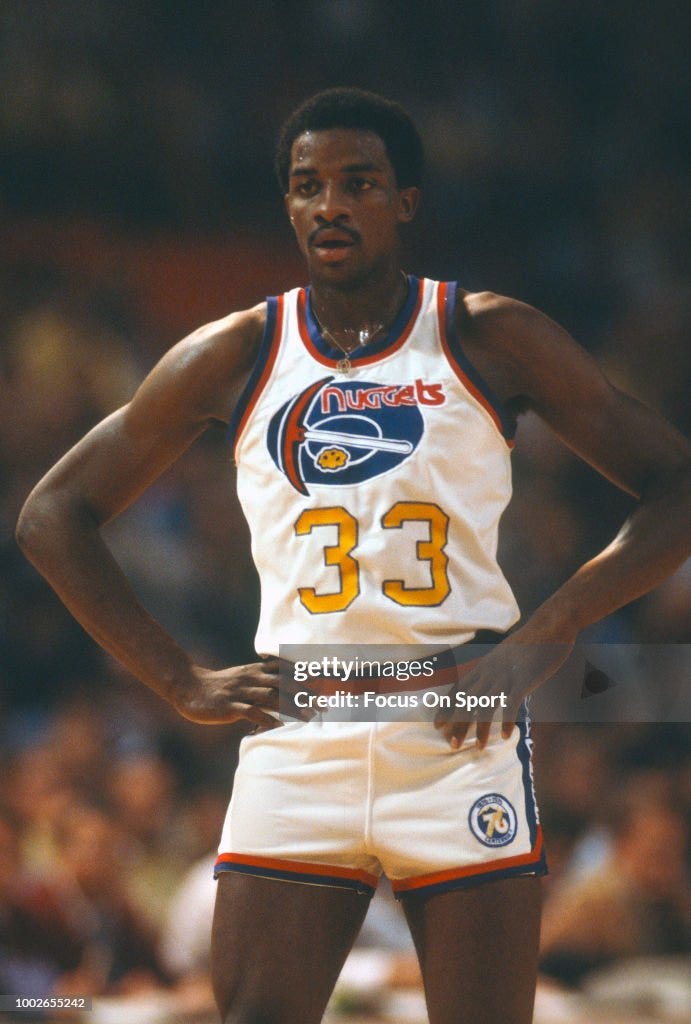
At the time, Thompson was still in college, plying his trade at NC State. I don’t remember who they played in the NCAA tournament, but the first time I got to watch him play he came down the lane towards a defender who waited, anticipating a charge, and Thompson just went…over him.
6’2” Thompson split his legs, and his crotch ran over the player’s head.
It was the most amazing thing I’d seen in my short life as a basketball fan, and I was hooked.
Life as a Nuggets fan living outside of Philadelphia wasn’t easy, at least in the 80s - they were a very good team, but overshadowed by the Lakers, rarely made onto the CBS broadcasts. At best, I’d watch with the TV on mute in the hallway upstairs after the 11 pm news, again witness to the Lakers eliminating Denver from the playoffs.
I was also frustrated with the limited analysis of Denver’s team, which usually commented about their amazing offense but terrible defense. Back then, the only team numbers I could access showed the Nuggets (usually) leading the league in scoring, and last in scoring defense. Pundits usually said they were a bad defensive team, and I thought that was…wrong.
Doug Moe ran a motion offense before it was chic, and he coached his teams to run and move the ball - when a player got the ball, they had two seconds to shoot, drive or pass. As a result, their games had more possessions than average, and I thought the higher the number, the scoring would be higher, no matter how good the defense.1
My freshman year in college most of the guys in my dorm were on the school team, so I became the statistician/manager. In addition to the basic stats, I tried to keep track of where our shots were taken from and how differently we performed depending on which five players were on the floor (today’s +/-), but that was too difficult to pull off in 1987 as a single statistician.
Division III athletic programs don’t pay statisticians.
Today, I pay more attention to the stats than I do the games.2 Average points per possession? Check. Number of pick and rolls per 100 possessions? Check. Effective FG%? NOM NOM NOM. But I think there’s still an area we could do better: rebounding.
Rebounds were one of the first stats the NBA tracked3 and since then they’ve broken them into offensive/defense rebounds, rebound percentage rates, but what they haven’t shown is a player’s ability to rebound better than expected, so let me introduce:
Rebounding Rate Over Average Rebounds, or RROAR.
For example, here’s a few Russell Westbrook rebounds, which earn him 0.00 RROAR:
I mean, Vern Troyer could have collected those rebounds, so Westbrook’s contribution had no added value, since the oppostion had given up on the ball (and a few times he teammates did as well, letting him pad his rebounding totals).
On the other hand, here’s Dennis Rodman:
Vin Baker is 6’11”; Rodman 6’7”. Baker has the positioning, Rodman has his tip drill perfected. I’m not sure what the RROAR would be, but I imagine it’s close to a full 1.00 RROAR, and for example, if the average player would get that rebound 20% of the time, Rodman would earn a .80 RROAR (conversely, Vin Baker would receive -.80 ROARR).
And somewhere between, NBA players gain (or lose) rebounds compared to the average situation. Positioning, height, anticipation all come into play which should be available given the level of tracking done at all NBA arenas today.
So why isn’t Second Spectrum doing this?
On December 13th, 1983, the Denver Nuggets lost to the Detroit Pistons 186-184 in what is still the highest scoring game in NBA history. According to legend, Pistons coach Chuck Daly (whose team ran in those days as well) told Moe before the game, “First one to 140 wins”.
Not because I don’t love today’s style (I do), but because I LOVE data analysis.
Assists and points have been around since the birth of the NBA (1947), and rebounds followed in 1950. Blocks and steals were first tallied in 1973, and since 2013 all the deep data dives with Second Spectrum began.